
 Eugene Wade
What do you do, in a world where you can’t go to the supermarket and pick up a can of Campbell’s Chunky Soup? Where you can’t call up Domino’s for a pizza?
Well… you’ll live a while on your food reserves. But after that…
…you’ll become a thief, a hunter or a gardener.
The first option is risky. Just think what happened with the horse thieves in the wild west. Plus, there are some people who would rather die than steal another’s food.
The second one will probably work for a month or so. If 300 million hungry Americans head out for the woods, how long will it take to exterminate the wild animals? We’ve already eradicated a few species.
When the remaining people will start to form communities, thievery will be the hardest way to “earn” a living. And when the wild animals become a rarity the hunting game will come to an end.
So… most of us will become gardeners
Agriculture didn’t just happen, it came out of gardening. Humans didn’t suddenly become farmers. They didn’t throw away their spears, stop hunting and round up cattle. Nor did they instantly stop foraging and start to grow fields of crops. In fact, the transition to agriculture was gradual. Humans became gardeners, dropping the seeds of their foraged food and seeing them grow. Those early experiments by our forefathers and mothers, led eventually to a world driven by agriculture.
They also had to protect their crops against looters (tribes) just like in a post-apocalyptic scenario. Things were rough back then.
What’s important to remember though is that those early gardeners didn’t have commercial fertilizers to play with; those guys were gardening from scratch, no help except nature and their own innovation, they were early gardeners.
We’re rapidly moving into a new world, one where we need to be prepared to go back to the days of using our own innovation to grow our own food. We need to bring back those skills to feed our families from a few sewn seeds.
Banking on Seeds
A modern phenomenon that will come back to haunt the guerilla gardener, is the use of Genetically Modified Organism (GMO) based crops.
Growing seeds in a future that may be cold, dark and fertilizer free, will be even more difficult as we see butterfly, bee and other beneficial insects that help us to cross-pollinate and grow our food, decline because of cultivation practices that Monsanto (for example) uses and promotes; practices that actually damage the environment, rather than optimize it.
Look out for ‘heirloom’ seeds. They’re seeds taken from old cultivar plants. Heirloom plants come from a wider diversity of plants and many of them have been cultivated with natural disease resistance through hybridization between plant species (see later about how to cross-pollinate plants).
Creating Tough Seeds
 Seeds need to be optimized to give good crops, having resistance to disease and being hardy for specific conditions, such as drought or cold…
Generating and collecting good quality seeds is crucial to creating robust and successive generations of plant. You can buy and start to store good seeds now, but these seeds may not be viable by the time you need to plant them. You are better placed to store some but grow more. You can then collect the seeds from those plants for future planting.
However, you may, at some point need to generate your own good seeds using cross-pollination methods, which can give you more robust and disease resistant strains.
This takes some experimentation. The most common method of doing this is to take two sturdy vegetable plants and ‘cross-pollinate’ them, that is taking the pollen from one plant and place it on the stamen (inside the flower) of another – a good method of doing this is to use a fine paintbrush, this is plant hybridization (Source).
When you eventually get a viable plant from this process, the seed from that plant is known as an F1-Hybrid and is often robust and can be highly disease resistant (I caveat this with the fact this takes trial and error experimentation).
How to Collect Seeds
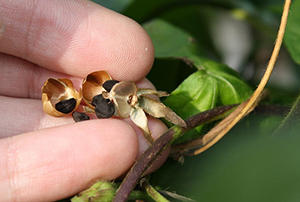 Collecting seeds is dependent on the plant, but certain general rules can be applied:
You can generally tell when the seeds are ready to collect because you’ll see a noticeable change in color in the plant, for example, green to brown. You can pick the heads of the plant, this is the part that contains the seeds, sometimes called a pod, and then leave it somewhere warm and dry. Once the pod has dried out, either the seeds will naturally fall out, or if the pod doesn’t open, you can gently crush it to release them.
Plants like berries are a little more difficult. The fruity part, containing the seeds needs to be crushed up, even mashed, through a sieve and the (often fine) seeds then need to be washed clean of any pulp. You can then leave them to dry by placing them on something absorbent, like a paper towel.
Nuts can be collected as they fall from the tree and released from their casing.
What is really important to remember with all seeds is to remove any extraneous material, such as casing, as this can rot down and become infected with fungus, effectively preventing the seed from germinating (i.e. growing).
Storing Seeds
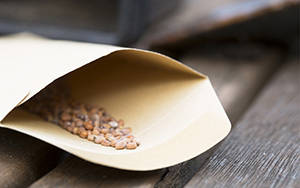 Once you have the seeds you collected yourself, or if you have bought in seeds from a supplier, you need to keep them safe and ready for planting. Seeds can last for years if kept in the right conditions. The ideal way to keep them is in the paper. Make small paper packets for each seed type and place them in (don’t forget to label and date them). Then keep them cool, the cooler the better and in a dark place.
The seed must be dry before storage; if you can get hold of some calcium chloride, all the better, as this is a desiccant and so removes moisture. The exception to this rule is walnuts, which conversely must not be allowed to dry out.
Growing in Difficult Conditions (Post-Apocalyptic)
Now you’ve got your seeds, you need to know how to grow them. It took me seven years to truly understand how to grow plants from seed. If you don’t already garden, practice now. If you don’t have a garden, use pots – you can even grow indoors if needs be, but gardening is something that is best learned by practice and germinating seeds is an art as much as it is a science (tomatoes are particularly tricky).
Water shortages
Water is crucial for good crop production. If you have problems with drought you need to take measures to manage water shortages, collect water and store it for use on your crops.
A fundamental thing to remember, not just for areas with low rainfall, is that good soil, which has a rich organic basis (ideal compost) will retain water better than poor soil.
You may, however, not have a lot of choice in your soil preparation at first, but you should bear this in mind and always generate compost from your waste.
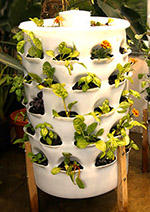 A useful trick to conserve water uptake by plants is to set them out in a block formation, rather than in rows – this reduces water loss and helps create shade. Or even better – Vertical Gardening (see picture)
Mulching is also a great way to stop water loss from the soil. Mulch is usually, some substance like torn up paper, or wood shavings and bark that is laid on the soil. However be careful what you use to mulch as certain woods, such as black walnut are poisonous to plants (see also notes on using a compost toilet below).
One useful method I have used to water vegetable plants frugally is to use an upturned, plastic bottle, filled with water. You need to put a few holes into the cap of the bottle and place it upturned, next to the plant, the water drips out slowly, enough to keep the plant watered and it means you don’t waste water on the unplanted ground.
Poor Light
There’s not a lot you can do if there is no light because vegetables love light. However, some vegetables can be grown in more shady and dappled areas. These include broccoli, cauliflower, peas, spinach, kale, certain salad vegetables like lettuce and some beans.
No chemical Growing
Organic growing is something we can find out a lot about now. Many people across the world, in a variety of environments, grow vegetables organically, with no chemical fertilizers. And of course, our forebears did this too. It is a case of working with what you have. For example, human urine, which is sterile, is a well-known fertilizer of vegetable plants as it is full of nitrogen and potassium. Giving your plants a personal watering does them a lot of good. On the subject of urine, compost toilets are an excellent idea and building one should be top of your agenda of things you need to know how to do. A compost toilet basically, composts your own waste products, which takes around 6 months. Once composted the resultant mulch can be used for plant food and as a way of controlling water loss from the soil.
Seeds for the Future with Ideas from the Past
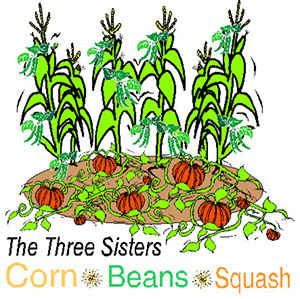 There’s a Native American gardening trick, known as the Three Sisters Garden which very cleverly uses the staple vegetable plants, squash, maize and climbing beans in ways which maximize the use of space and conditions so that each helps the other to grow more optimally. It is worth looking at this concept of co-operative planting and remembering that gardening needs thought, it will feed us, even help cloth us; it is a skill that each of us needs to learn.
Another way is to have a system totally independent of the environment in a small, leveled space, like Aquaponics.
We need to become gardeners to assure the future of our current and future family members.
“The greatest fine art of the future will be the making of a comfortable living from a small piece of land.” (quote – Abraham Lincoln)




We have all heard the story of Johnny Appleseed. In my opinion he was the original Guerilla Gardener in the USA. I live in Florida for a number of reasons with regard to survival. #1 in all of these is the 3 growing season climate. That said I have a black thumb and a short attention span. I give seeds and seedlings tons of attention and care but once I have them in the ground, my attention wanes and watering, weeding, and fertilizing declines greatly. I try to grow things that reseed themselves or are perennials. Often the plants I choose are near invasives. Others a commonly known to have been grown by Native Americans in my area. BTW just a quick note, David the Good on youtube is sort of my guru on all this. Here is a list of the things I have already established or am playing with at present: Muscadine Grapes, Passion Fruit, Goji Berry, everglades wild cherry tomatoes, Seminole pumpkin, Chinese wild yams, red ivy gourd, yardlong beans, yacon, naranjilla, dwarf tamarillo, cocona, pawpaw, cassabanana, and kiwano. I save seed, can fruit veggies and fish, poultry, and meat.
.
My advice to all is this. Experiment now and find what thrives in your area. If great effort is required to reap a small return in produce, it might be something you should not depend on for survival. Great returns for little effort are what you should be looking for because you may have more pressing needs than gardening in a post catastrophe situation.
Mark: you write “Another way is to have a system totally independent of the environment in a small, leveled space, like Aquaponics. Here you can find more details on how to build your own Aquaponic System.” I don’t want to buy a book. It would be nice if you provided any of the many links to websites that show how to build an aquaponics setup. There are many good ones out there; I know, I’ve used them.
My wife and I are big gardeners growing almost all of our own veggies..Green beans, butter beans, black-eyed peas, corn, okra, tomatoes, cucumbers, many types of peppers, onions, carrots, squash, melons, berries and last year I planted 46 pecan trees. We use lots of mulch (free). Find a tree service near you. Most of them will gladly dump as many wood chips as you want for free. Our soil keeps getting better every year and that is in the Georgia red clay. Now it is getting a nice dark brown color. My next project is asparagus beds. I love this site. Lots of good info.
I live in zone 9 near the GOM. Grew up with family garden every year, abandoned the practice for decades and for past 10 years relearning gardening. Took lots of organic matter and several years to develop good garden soil. Have accepted fact that different crops have bumper and failure years. Along with vegies I have also concentrated on medicinal and culinary herbs. Collect and replant seeds, though have difficulty with the ‘tiny’ seeds. Took a long time to realize that some crops must be planted in the fall or late winter rather than in spring.
A few items of interest are heat tolerant Malabar Spinach and Yard Long Beans, borer resistant solid stem Winter Squash, Cat Mint (AKA Catnip), Elderberry and Blackberry – easy to grow and almost invasive. Currently determining how tolerant and perennial Asparagus, Ginger, Horseradish and Jerusalem Artichoke are.
Only wish that I had started fruit and nut trees several years ago. A perennial forest would be optimal but also need to know how to grow, harvest and save annuals that can be taken elsewhere.
Develop your green thumb now. If you wait until you need it you may not have the years needed to learn.
Can I get this in book form? If there is an EMP I won’t be able to use my computer, so why the digital book only?!? I am a person who wants and learns better having a tangible book in my hand to refer to as needed.